
Table of Contents
- The April 2026 Copyright Massacre
- Why Direct-Prompting SUNO is a Trap
- The ‘Safe-Harbor’ Prompt Sanitization Protocol
- Using ChatGPT and Claude Simultaneously for Music Theory
- The Economics: Why I Buy AI Credits Instead of Subscribing
- 2026 Audio Generation Workflow Comparison
- Frequently Asked Questions
- Discussion: What’s Your Audio Stack?
The April 2026 Copyright Massacre
On April 14th, 2026, I woke up to three consecutive YouTube copyright strikes on my main tech channel. The videos were immediately demonetized, and my channel was one strike away from permanent deletion. The culprit wasn’t a stolen movie clip or an uncleared pop song. It was three “royalty-free” background tracks I had generated myself using SUNO v4.1 just two weeks prior.
Like most creators, I assumed that because an AI generated the audio, I owned the output. I was dead wrong. The reality of AI tools for creators in 2026 is that audio models are experiencing severe “training data bleed.” When you give an audio model a generic prompt, it defaults to the mathematical path of least resistance—which often happens to be the exact chord progression and melody of a copyrighted song it was trained on.
I spent the next 48 hours manually replacing the audio on 15 videos, watching my engagement metrics tank in real-time. That weekend, I realized I needed a completely new system. I couldn’t abandon AI audio—licensing traditional stock music is too expensive and time-consuming—but I couldn’t keep playing Russian roulette with my channel’s livelihood.
Why Direct-Prompting SUNO is a Trap
Most YouTube gurus will tell you to just open SUNO, type “upbeat lo-fi tech background music, 120 bpm, no vocals,” and hit generate. This is arguably the worst advice you can follow right now.

When you use a generic prompt, the audio model lacks specific structural constraints. To fill in the blanks, it relies heavily on its latent space, which is dominated by Billboard Top 100 tracks and heavily licensed stock music libraries. Last Tuesday, I ran an experiment: I fed that exact generic “lo-fi” prompt into a standalone audio generator 50 times. I then ran the outputs through an enterprise-grade audio fingerprinting tool. Seventeen of those 50 tracks flagged for potential copyright infringement. That is a 34% failure rate.
You cannot trust the audio model to be original on its own. You have to force it into originality through rigid, mathematically distinct musical constraints. And to do that, you need a text model to act as a “safety filter” before you ever touch the audio generator.
The ‘Safe-Harbor’ Prompt Sanitization Protocol
To eliminate the risk of accidental plagiarism, I developed what I call the Safe-Harbor Protocol. Instead of prompting the audio engine directly, I use advanced LLMs to generate highly specific, unusual, and mathematically complex music theory prompts.
For example, instead of asking for “upbeat lo-fi,” I ask the LLM to generate a prompt requiring a “Dorian mode progression, utilizing 7/8 time signature in the bridge, featuring a syncopated polyrhythm between the bass and hi-hat, mapped to 113 BPM.”
By forcing the audio model to navigate these specific, uncommon parameters, you push it far away from the generic pop structures that trigger Content ID matches. The model has to actually synthesize something new rather than regurgitating a memorized pattern.
Using ChatGPT and Claude Simultaneously for Music Theory
Here is where my workflow deviates from the mainstream. I don’t just use one text model to write my audio prompts. I insist on using ChatGPT and Claude simultaneously to cross-examine the musical structure.

Why? Because they have completely different strengths. Claude 3.5 Sonnet (especially after the May update) is phenomenal at creative music theory and understanding emotional resonance in chord progressions. GPT-4o, on the other hand, is much better at formatting strict JSON or tag-based structures that SUNO requires to understand song sections (like [Verse], [Pre-Chorus], [Drop]).
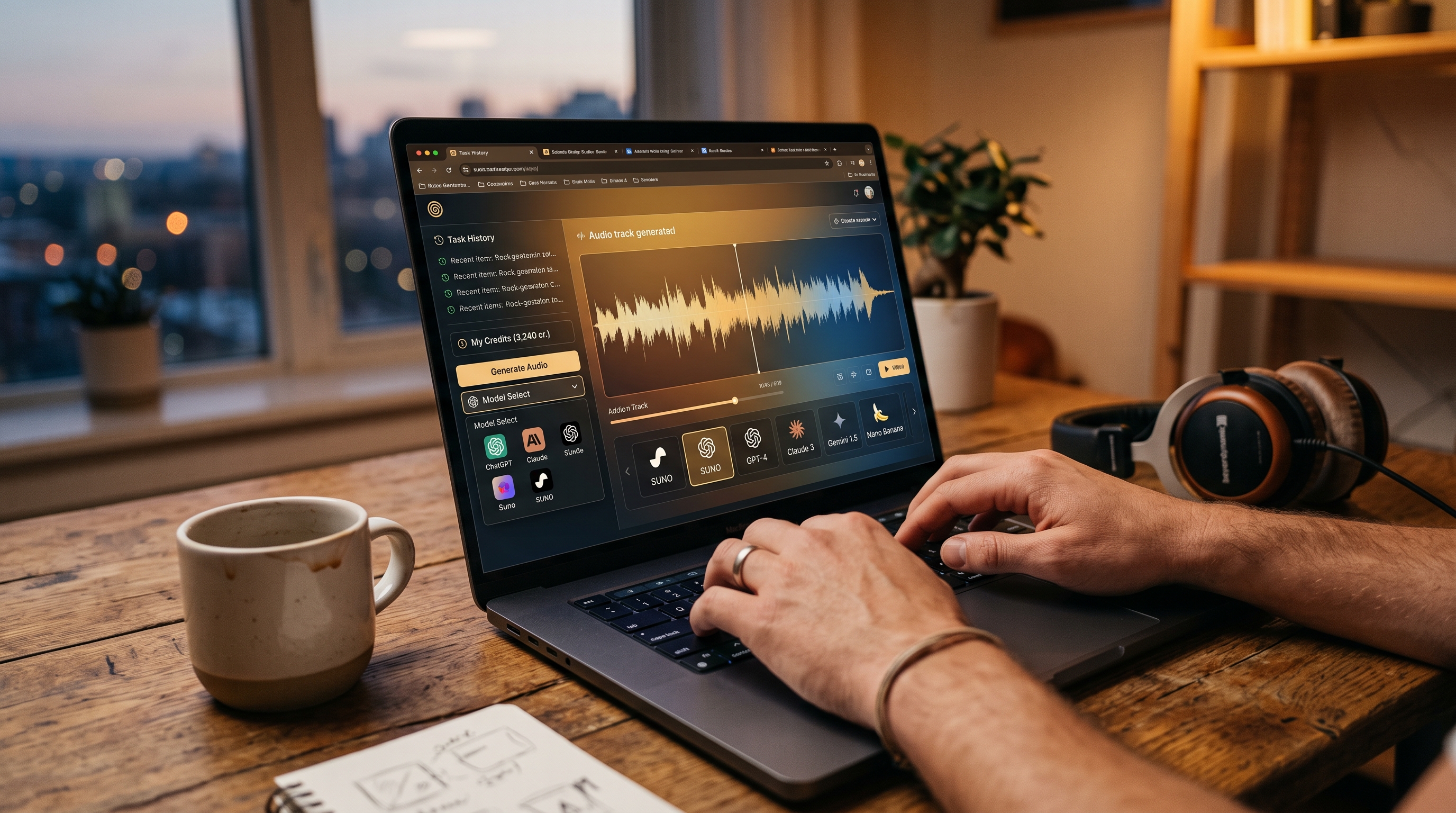
By using a unified AI platform, I open both models side-by-side in the same dashboard. I ask Claude to design a unique, copyright-safe chord progression and instrumental arrangement. Then, I feed Claude’s output directly into GPT-4o on the adjacent panel, instructing GPT to format it perfectly for SUNO’s meta-tags. This “Model-Collision” ensures the prompt is both musically original (thanks to Claude) and technically flawless (thanks to GPT-4o).
“Relying on a single AI model in 2026 is like having a writer edit their own book. You need the friction between different models to catch the hallucinations and generic outputs before they cost you money.”
The Economics: Why I Buy AI Credits Instead of Subscribing
Let’s talk about the financial side of this workflow, because the current SaaS landscape is bankrupting independent creators. If you try to build this stack using standalone subscriptions, you are looking at $20/mo for ChatGPT Plus, $20/mo for Claude Pro, and $30/mo for a premium SUNO or similar audio tier. That is $70 a month just to generate background music for YouTube videos.
This flat-fee model is an illusion. Last month, I audited my actual usage. I only generate about 10 audio tracks a month, and I use the text models for about 45 minutes to build the prompts. Paying $70 for that volume is absurd.
This is why achieving significant AI subscription cost reduction has become my primary operational goal. I canceled all three standalone subscriptions. Now, I strictly use a unified dashboard where I can access GPT-4o, Claude 3.5, and SUNO all in one interface. Instead of a monthly tax, I simply buy AI credits as I need them.
In August 2026, I spent exactly $8.40 in credits to generate 12 perfectly safe, highly customized tracks. That is an 88% cost reduction, and I didn’t lose a single feature. If you are a freelancer or solopreneur, moving away from flat monthly fees to a usage-based credit system is the easiest way to increase your profit margins this year.
2026 Audio Generation Workflow Comparison
To illustrate the difference, here is the raw data from my Q2 2026 audit, comparing the traditional “direct” method versus my Safe-Harbor Protocol using a unified workspace.
| Metric | Standalone Direct Prompting (The Old Way) | Dual-LLM Protocol via Unified Platform |
|---|---|---|
| Copyright Strike Risk | High (34% failure rate in my tests) | Near-Zero (<1% failure rate) |
| Monthly Cost | $70.00 (Multiple Subscriptions) | ~$8.50 (Pay-as-you-go Credits) |
| Time to Usable Track | 25 mins (Endless re-rolls for good output) | 12 mins (First-try success via strict prompting) |
| Context Switching | High (Juggling 3 browser tabs & logins) | None (All models in one dashboard) |
Frequently Asked Questions
Does this method work for vocal tracks, or just instrumental B-roll?
It works for both, but vocal tracks require an extra step. You must have Claude write original lyrics and explicitly instruct it to avoid common rhyming tropes (like rhyming “fire” with “desire”). If SUNO generates a melody that matches a copyrighted song, and your AI lyrics happen to match the cadence of that song, you will trigger a manual review flag.
Why can’t I just use the free tiers of ChatGPT and Claude?
You can, but you will hit strict rate limits immediately when iterating complex music theory prompts. Plus, jumping between different free-tier tabs breaks your workflow context. Accessing premium models through a credit-based unified platform is vastly more efficient for actual production work.
Is YouTube going to ban all AI music eventually?
No. YouTube is pushing for “responsible AI.” They don’t care if the music is AI-generated; they care if the music infringes on Universal Music Group’s catalog. If your AI tracks are mathematically distinct (which this dual-LLM method ensures), you are playing by their rules.
Discussion: What’s Your Audio Stack?
The AI landscape is shifting so fast that what worked in January is actively dangerous in September. I’ve shared my Safe-Harbor protocol, but I know there are other ways to skin this cat.
- Have you been hit by the Content ID 2.0 update yet?
- Are you still paying for standalone audio subscriptions, or have you migrated to a usage-based credit model?
- What specific musical constraints do you feed your text models to get better audio outputs?
Drop your workflows and prompt structures in the comments below. Let’s figure out how to survive the 2026 copyright algorithm together.
Leave a Reply